ACT vs SAT for High School Students Which Test Fits Your Student Best

Choosing between the ACT and SAT can feel like picking a lane before the student has even seen the road. Both exams are accepted widely by U.S. colleges, and neither is objectively “better”. The better choice is the one that matches how a student reads, calculates, handles time pressure, and stays focused under test conditions.
The biggest differences come down to pace, question style, math expectations, and science reasoning. A student who understands those differences can make a smarter testing plan, often with less stress and wasted prep time.
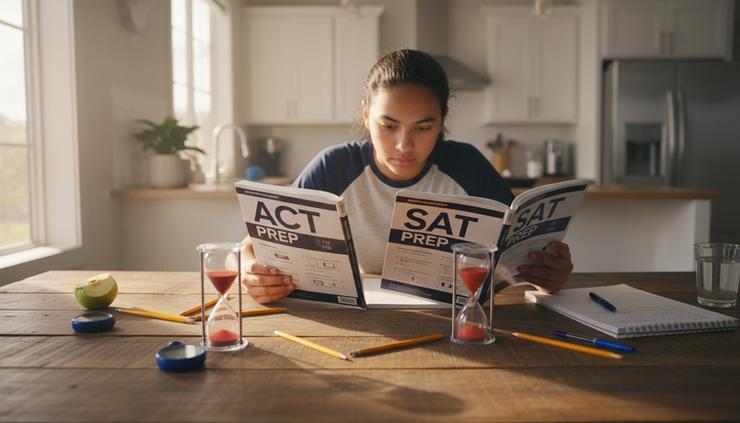
The ACT and SAT measure similar skills in different ways
Both tests measure college-readiness skills, but they do it by different means.
The SAT is now a shorter digital test. It includes Reading and Writing, then Math. The questions adjust in difficulty based on performance during the test, which is called adaptive testing. Students see shorter reading passages with one question tied to each passage.
The ACT is more section-based and faster paced. It has English, Math, Reading, and an optional Science section, which the student can opt out of depending on college requirements. The ACT often rewards students who can move quickly and stay accurate across many questions.
Timing is one of the biggest differences
The SAT gives students more time per question on average. The ACT asks students to work faster, especially in the Reading and Science sections.
Test area | SAT timing and format | ACT timing and format |
Reading and English skills | Reading and Writing section with short passages and grammar questions - 54 questions in 64 minutes. | English, passage-based - 50 questions in 35 mins. Reading section, 4 passages, 9 questions each in 40 minutes |
Math | 70 minutes for 44 questions | Math is faster paced, with less time per question |
Science | Not tested seperately - topic included in Reading/Writing sections | Science is a separate reasoning section, which is now optional |
Total testing time | 2 hours and 14 minutes, not including breaks | English, math and reading sections - 2 hours and 5 minutes. When Science is included - 2 hours and 45 minutes (no breaks included) |
A good test fit is not just about what a student knows. It is also about how well the test’s pace matches the student’s natural working style.

Question types feel different on each test
The SAT often asks students to think more deeply about fewer questions. The ACT often asks students to move quickly through more direct questions tied to the questions.
Reading and writing
On the SAT, Reading and Writing questions use short passages. Students may answer questions about vocabulary, main ideas, evidence, grammar, and sentence structure. The shorter, denser passages can help students who dislike long reading sections.
On the ACT, English questions are tied to longer passages and focus heavily on grammar, punctuation, sentence order, and style. The Reading section uses longer passages and asks students to answer a set of questions about each one.
A student who is skilled at more detailed reading in small chunks may prefer the SAT. A student who can read longer, straight forward passages quickly may do well on the ACT.
Math
SAT Math allows a calculator throughout the math section, including access to a built-in digital calculator. Its questions often focus on algebra, problem solving, data analysis, and some advanced math.
ACT Math tends to move faster and may include a broader spread of high school math topics, including algebra, geometry, and trigonometry. The questions are often direct, but students need to recognize the method quickly. Students bring their own approved calculator.
If a student is strong in algebra and likes working through multi-step problems, the SAT may be a good match. If a student has broad math knowledge and can work fast, the ACT may fit better.
Science reasoning
The ACT Science section is often misunderstood. It does not mainly test memorized biology, chemistry, or physics facts. Instead, it asks students to read charts, compare experiments, interpret data, and draw conclusions.
Students who like graphs, lab-style passages, and data may enjoy this section. Students who feel rushed by visual information may find it stressful.
The SAT does include charts and data questions, but these cover a variety of topics including science, economics, and linguistics.

How to choose the best test for your student
The most reliable way to choose is simple: have the student take one timed practice SAT and one timed practice ACT. Use official-style practice materials if possible, and keep the conditions realistic.
Then compare more than the score.
Look at these factors:
Score comparison Use concordance tools or score comparison charts to see which result is stronger.
Timing comfort Notice whether the student ran out of time, guessed often, or felt rushed the whole way through.
Error patterns A student missing questions from rushing may need a different strategy than a student missing questions from content gaps.
Energy level Some students stay focused on the shorter SAT. Others prefer the ACT’s clear subject sections.
College requirements Most colleges that accept test scores accept both. Some programs, scholarships, or states may have specific preferences, so check before building a plan.
A student should usually focus prep on the test that gives the best combination of score potential and confidence. Preparing for both at the same time can work, but it often spreads effort too thin.
Quick recommendations based on student strengths
The SAT may be the better fit for a student who:
Reads carefully but not especially fast
Prefers shorter passages
Likes algebra and data-based math
Wants more time per question
Gets overwhelmed by rapid section pacing
The ACT may be the better fit for a student who:
Reads quickly and accurately
Handles time pressure well
Has strong grammar skills
Knows a wide range of math topics
Feels comfortable reading charts and experiment summaries
For many students, the first practice test does not tell the whole story. A student might score slightly higher on one test but feel much better about preparing for the other. That matters. Confidence can lead to steadier practice, and steady practice usually leads to better results.

The best test is the one that fits the student’s habits
The ACT vs SAT for high school students decision should start with evidence, not rumors. One student’s “easier test” may be another student’s worst fit.
Start with two timed practice tests. Compare the scores, pacing, mistakes, and stress level. Then choose one test and build a focused prep plan around it.
A strong choice is not always the test with the most familiar name. It is the test that gives the student the best chance to show what they know, stay calm, and finish strong.



Comments